In this article, we explore the importance of selecting the right greenhouse glass type and quality for leafy greens production, taking into account the advantages and limitations of each option.
Why light transmission matters for greenhouse production
A fundamental rule of thumb in horticulture states that every 1% increase in usable light can result in approximately 1% higher production when applied correctly. This principle highlights the importance of maximizing light transmission in greenhouse facilities and is a key consideration for anyone pursuing sustainable greenhouse production.
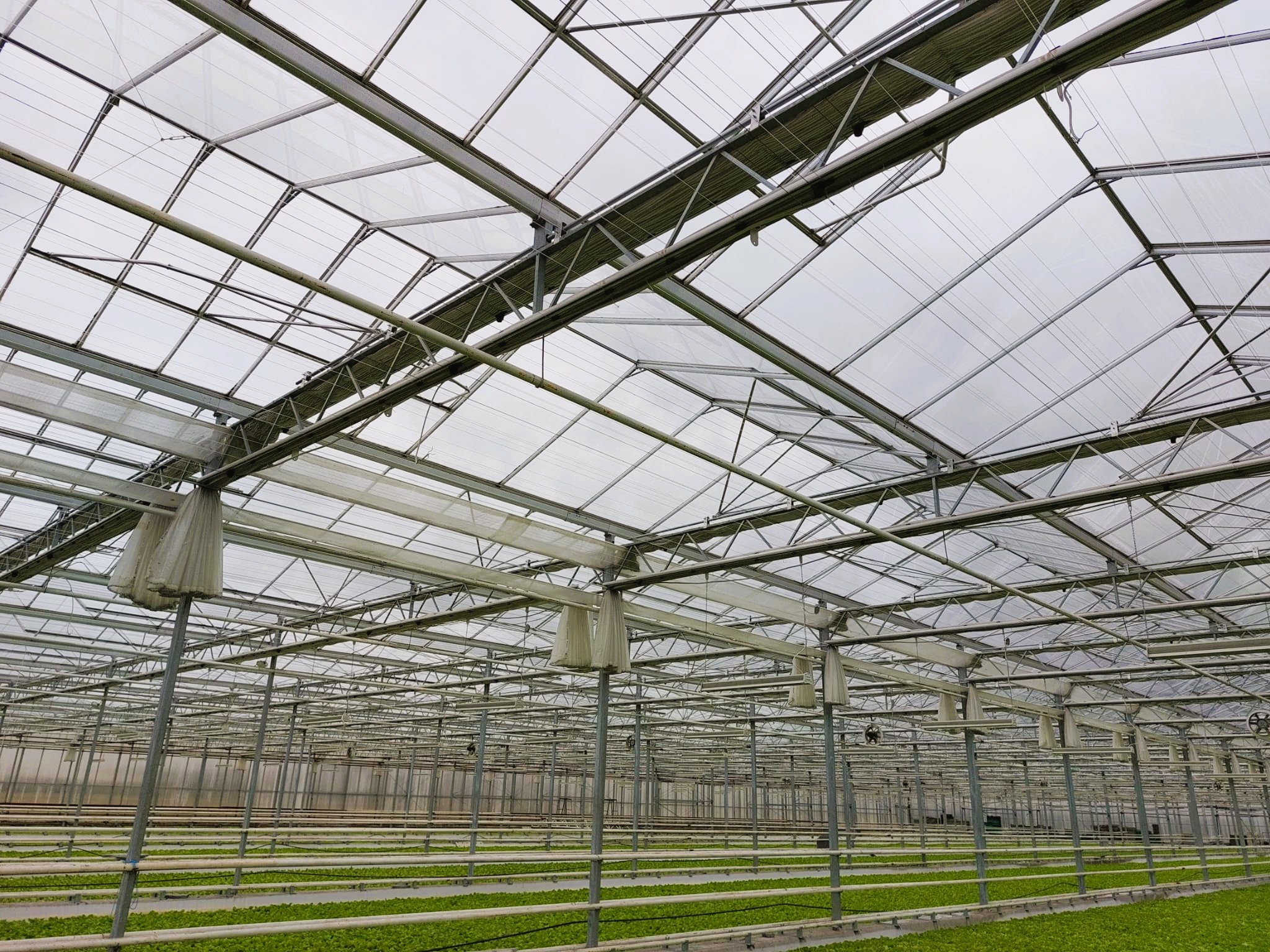
For this reason, growers and facility managers should regularly clean greenhouse roofs to remove dirt, algae, and dust, and consider using anti-reflective (AR) coatings on greenhouse glass. AR coatings reduce reflection losses and allow more light to reach the plant canopy, directly improving growth speed and crop performance. This is especially important during spring and autumn when light availability fluctuates.
Understanding light measurements
Light can be expressed using several units, including:
- Watt/m² – light intensity
- Joule/cm² – light sum
- µmol/m²/s – photosynthetically active radiation (PAR) intensity
- mol/m²/day – daily light integral (DLI)
In practice, different growers use different metrics. However, to accurately assess the PAR light reaching the canopy at a specific moment, µmol/m²/s is the most appropriate unit. When evaluating total daily light exposure, mol/m²/day is recommended.
Glass material and transmission
The material from which greenhouse glazing is made plays a critical role in light transmission. Compared to standard glass, 4 mm AR-coated glass is highly recommended, as it significantly improves light transmission.
For plastic greenhouses, investing in an ETFE membrane instead of conventional PE film offers higher transmission, improved durability, and better long-term performance.
Low-iron glass for leafy greens
For leafy greens production, especially for red lettuce varieties used in lettuce cultivation, low-iron glass is strongly recommended. This glass type improves color development, enhances leaf thickness, and allows higher UV and PAR transmission compared to standard float glass.
Advanced greenhouse glass technologies
As greenhouse technology continues to advance, several innovative glass options are now available for new facility developments.
Smart glass
Smart glass can dynamically adjust its properties—such as light transmission, shading, and heat control—in response to external stimuli like light intensity, temperature, or electrical input. Proper humidity management in greenhouses works in tandem with these advanced glazing solutions.
Key benefits include:
- Automatic shading to reduce overheating
- Energy savings through controlled solar gain
- Reduced crop stress during periods of intense radiation
F-Solar glass
F-Solar is a low-iron, high-transmission glass designed for greenhouse and photovoltaic integration. Its key properties include:
- Very low iron content
- Light transmission up to 91–92%
- Anti-reflective coating
- UV stability and high durability
- Toughened structure for impact resistance
Albarino Crystal Clear+
Albarino Crystal Clear+ is a high-transparency greenhouse glass with a specially etched surface that diffuses light evenly while maintaining high PAR transmission.
Its main advantages include:
- High light diffusion (approximately 70–80%)
- Uniform light distribution with minimal shadowing
- Reduced risk of sunburn and hot spots
- Very low iron content
This glass is particularly suitable for sensitive crops and vertical farming systems or dense cultivation systems where deep light penetration is critical.
Closing remarks
Choosing the right greenhouse glass is a strategic decision that directly influences light availability, crop quality, and production efficiency. Each glass type offers specific advantages depending on crop type, climate, and production strategy.
At Agranom, we remain committed to supporting the development of the CEA leafy greens industry by bridging the gap between advanced greenhouse technologies and real-world execution. Our goal is to help growers and investors build efficient, profitable, and future-ready leafy greens facilities.
For further information or expert support, please contact denis.laci@agranom.nl or visit www.agranom.nl.