As discussed in our previous articles, there are three key environmental parameters that growers can actively manage to maximise photosynthesis rates: temperature, light (radiation), and CO₂ concentration.
We have already covered temperature and light levels. Now, let’s take a deeper look at the importance of CO₂ enrichment in leafy greens cultivation. When should CO₂ be applied? What are the available dosing methods? And what benefits can growers expect from its proper application?
1. Understanding CO₂ concentration
Atmospheric CO₂ concentrations were approximately 280 ppm during pre-industrial times (18th century), compared with more than 420 ppm today.
CO₂ is also heavier than the average composition of air. This physical characteristic can influence its distribution within a greenhouse, although actual air movement and CO₂ uniformity are also strongly affected by temperature differences, ventilation, and air circulation systems.
2. How is CO₂ distributed inside greenhouse installations?
Commercially, CO₂ enrichment in greenhouse installations can be implemented through different distribution systems, depending on the greenhouse design and cultivation system.
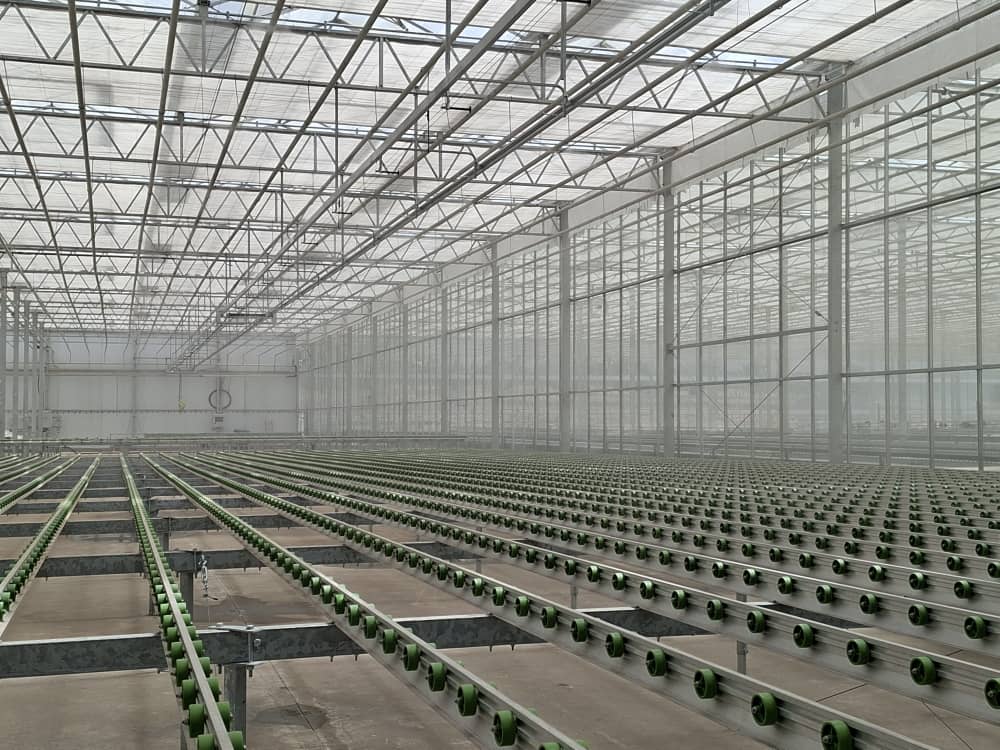
In semi-closed greenhouse installations, CO₂-enriched air can be distributed through dedicated pipes located underneath the cultivation tables and directed upwards, allowing it to circulate between the gutters and around the crop canopy.
When CO₂ is supplied from a liquid source rather than directly through a boiler system, distribution can be achieved through small-diameter plastic pipes installed at different locations throughout the facility.
The most common installation places these pipes underneath the gutters. However, in facilities operating with ebb-and-flow or DWC systems, distribution can also take place from the sides of the growing area or, in certain configurations, through pipes positioned above the crop canopy.
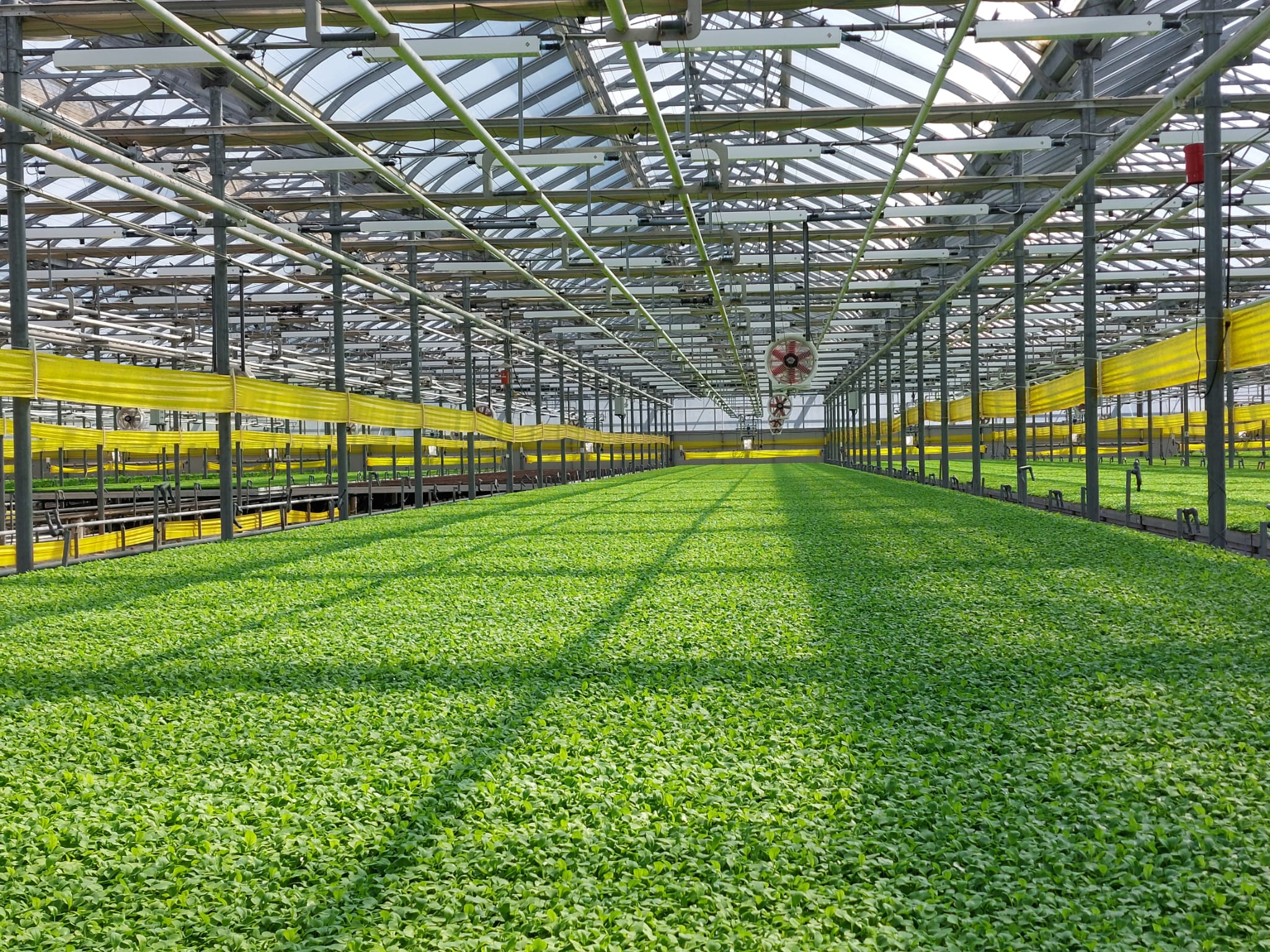
The objective is always to achieve a relatively uniform CO₂ concentration around the plants.
3. What are the benefits of CO₂ enrichment?
The main benefit of CO₂ enrichment is its direct contribution to photosynthesis.
CO₂ is one of the essential raw materials used by plants during photosynthesis to produce (sugars). These sugars provide the energy and building blocks required for plant development, new cell formation, and dry matter accumulation.
Consequently, when CO₂ is supplied at appropriate concentrations and in combination with sufficient light and suitable temperatures, growers can stimulate photosynthesis, increase biomass accumulation, and potentially improve total crop yield.
Various research studies have investigated the optimal CO₂ concentrations for leafy greens production. In commercial greenhouse cultivation, concentrations commonly range between 600 and 1,000 ppm, depending on crop type, environmental conditions, and the available light intensity.
It is important, however, to monitor CO₂ concentrations carefully. Higher concentrations do not necessarily translate into higher productivity, as the benefits depend on several interacting environmental factors. Excessive dossing should be avoided, and crop-specific thresholds and workplace safety requirements must always be considered.
4. When should CO₂ be dosed?
Another very important aspect is the timing of CO₂ enrichment.
CO₂ dosing should take place during the day period, meaning when natural or artificial light is available and photosynthesis is actively taking place.
As we increase light intensity and temperature, we should also consider increasing CO₂ availability to ensure that the plants have sufficient resources to maintain higher photosynthesis rates.
In other words, these three parameters should always be managed together rather than independently.
During the night, when there is no light available for photosynthesis, CO₂ dossing generally provides no production benefit. Plants continue to respire, but the photosynthetic process is inactive. Therefore, CO₂ dosing should normally be switched off during the dark period.
Particular attention should be given to the automation and control systems to ensure that CO₂ enrichment operates only when required.
5. The importance of understanding CO₂ management
As you can imagine, understanding how CO₂ is distributed, absorbed, and utilised by plants is essential for optimising production output.
Correct CO₂ management, combined with proper temperature and light, can significantly improve the efficiency of the growing environment and help growers achieve higher productivity.